
In 1956 Matson established the shipping industry’s first integrated research company to develop more efficient and economical ways of moving goods to the Pacific Islands. Two years later in 1958, Matson shipped the first prototype refrigerated container to Hawaii from the West Coast. Since that first refrigerated shipment over 45 years ago, Matson has been an industry and trade leader in the development and handling of refrigerated cargo moving to the Pacific Islands. Today Matson has an inventory of over 4,000 state-of-the-art refrigerated containers in service and available to our customers.
Matson has a long history of innovation in the handling of refrigerated cargo being shipped to the Pacific Islands. That spirit of continual improvement has resulted in one of the best refrigerated cargo systems in the shipping industry. Careful consideration of customers’ needs resulted in the following state-of-the-art characteristics:
Temperature control to within less than one degree
Precise control for transporting extremely temperature-sensitive cargo such as pharmaceuticals
Availability of Modified Atmospheres to limit cargo respiration rate Reduces or eliminates the presence of carbon dioxide, nitrogen and /or oxygen to reduce or eliminate spoilage from interaction with these gases; single insertion of atmosphere at time of loading; most effective for short-duration voyages
The use of substitute atmospheres for Controlled Atmosphere applications Further retards ripening by maintaining a substitute atmosphere for the duration of the voyage
The most advanced sealing techniques are used to construct and test our refrigerated containers Matson’s refrigerated containers minimize the loss of atmosphere during transit—and Controlled Atmosphere systems maintain the selected atmosphere during transit until the container is opened
Special design to minimize tare weight
Content weight can be maximized on inland transportation
Length and height choices to accommodate a variety of needs
Several container lengths and two heights provide a selection of total cargo capacity choices depending on the type of cargo and packing density desired
Motor- generators for inland shipping where no other power is available
Temperature control continues during Port to Door inland transportation
Remote reefer monitoring
On-board operators can check refrigerated container conditions using an on-board PC:
Temperature
Action Required alerts
Upload a long-term history of unit temperature
These features are all designed to provide the highest level of refrigerated product quality and integrity, and maximum payload during transit, whether ocean transit or inland trucking to the final destination.
Modern refrigeration containers combine maximum capacity and airflow with pinpoint temperature control to deliver uniform protection throughout the load. Matson’s units can control the temperature within a degree of the initial temperature setting (a critical requirement for pharmaceutical shipments, for example). There are also “dual-zone” units available which allow two different levels of chilling in the same container.
Matson owns specially built and equipped containers for Modified Atmosphere(MA) and Controlled Atmosphere(CA) applications. This equipment is built with ports on the front of the containers to facilitate the efficient flow of specific atmosphere gases to enter into the container while forcing the oxygen and other present gases out.
Modified Atmosphere (MA)
All refrigerated products require protection from heat, cold or certain gases, including oxygen, to impede deterioration of the goods and chemical reactions with gases. At the shipper’s request, Matson can arrange for one of several leading technology companies to provide Modified Atmosphere inside our container at the port of origin.
Controlled Atmosphere (CA)
For longer transit times, a Controlled Atmosphere maintains a constant level of a substitute atmosphere throughout the transit to slow the natural ripening process. This allows produce to be loaded into containers closer to the sail date allowing produce to ripen longer in the field, making them higher in value at destination. Controlled Atmosphere is another product available from leading technology companies that will be inserted into our specially designed containers at the port of origin.
Click here for our Atmosphere Modification Service Provider.
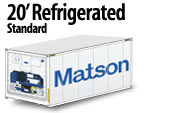
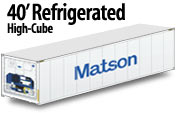
Matson offers 24-foot and 40-foot high-cube refrigerated containers to service the needs of our customers shipping to and from Hawaii. The equipment is capable of handling chilled and frozen cargo across the Pacific to protect the integrity and quality of the goods. For Saipan and Micronesia 20-foot standard and 40-foot high-cube units are available. Please note there is no 20-foot refrigerated equipment to Guam and Rota.
Most Matson reefers are dual voltage, thereby saving the cost of separate, dual-voltage transformers mounted at the shipper’s facility.
While our equipment is in transit between the port and the customer’s facility, depending on the commodity and distance traveled, power for the reefers can be provided by Matson’s chassis-mounted, under-slung, diesel-powered generators which provide 220 / 440-volt, three phase electric power when away from a normal power source. Motor generators add weight to the container and chassis and this additional weight must be factored into the loading of the container in order to be compliant with over-the-road weight limitations
All of Matson’s equipment goes through a process of cleaning and calibrating after we receive the equipment back from our customers. This process, also known as a Pre-Trip, is completed after each movement of freight and before the equipment leaves the terminal for the loading of a new shipment. The calibration is a process which entails a check of the unit to determine that it is in good working order. When this process is completed, the unit is set at a standard temperature of 35 degrees
Temperature Setting & Motor Generating Operating Instructions
Ensure power cord is plugged into genset receptacle and check fuel level to ensure full tank. Capacity equals 50 gal. (1 gal per hour)
White genset (460v) – use yellow cable
Red genset (230v) – use black cable
Push in completely, circuit breaker located above genset receptacle.
To start red genset:
Depress and hold black rubber covered button for approximately 10 seconds
Raise toggle switch (located left of push button) to upper position
Unit will then start on its own
To start White genset:
Raise ignition toggle switch to run position
Unit will start
Once genset has started:
On reefer unit with BLUE front, make sure ST toggle switch (located to the far right) is in the I position (up). Set desired temperature using the up and down arrow keys, then PRESS enter.
On reefer units with WHITE front (Thermoking) on control box at far left side of unit ensure upper toggle switch on lower right side of box (outside of control box) is in up position.
Raise control box latch handle on right side of box and open box door. Use set point arrows; up or down to get desired set temperature and PRESS enter.
For questions and concerns please contact our Customer Service Center Refrigerated Group 800-662-8766.
In order to meet the requirements of our customer's shipping temperature sensitive cargo, Matson has put into place a national sales and customer service team to cater to customers shipping refrigerated cargo. Our National Refrigerated Cargo Sales Team is available to support customers across the mainland and throughout the islands. For Sales or Customer Support, please call 1-800-9-MATSON
Additional Information: U.C. Davis Postharvest Technology, Research and Information Center
The following reference is provided for the benefit of our shippers and consignees. Matson has not independently confirmed this information and has no liability for any errors or omissions with respect to this data. Matson will abide by the shipper's instruction as to the temperature setting for all refrigerated shipments even if it differs from the information provided herein and will have no liability for loss or damage caused by following the shipper's instruction.